
Some people enter filmmaking through cameras and film schools. Kolja Kaldun came in through something far more tactile: the weight of an object in the hand, the texture of a surface, and the quiet moment when a performer believes in what they are holding.
That is because, for more than thirty years, Kolja worked professionally as a magician. The close up magic has taught him an essential lesson early on: If an audience can touch something, it cannot be fake in spirit. It has to feel real.
In his words, props should “not only look convincing but also tell their own story.”
Indeed, for Kolja, the technical difficulty of a trick was never the focus. What mattered was the magic and the story behind it. Hence, the prop exists to support that story and make it feel real to the audience.
That mindset did not disappear when he stepped away from the stage. It just simply changed its form.
Meet Kolja Kaldun and his inspiring journey from stage-work to film-set.

How Different Worlds Shaped One Perspective
If you try to trace Kolja’s path back to a single starting point, you won’t find one easily. His way of working grew out of several worlds at once, in the best way, because it was shaped from many directions coming together.
Alongside performing, Kolja learned carpentry, simply because he wanted to build things with his own hands. What began as a practical impulse grew into a serious craft. Through making, he learned how objects are constructed, how they age over time, and how they behave once they pass into someone else’s hands.
Over the years, while searching for the right materials and solutions, he met many inspiring people whose ideas stayed with him. Each encounter left its trace, gradually shaping the way he thinks about objects, not just as things to be built, but as carriers of meaning within a story.
At the same time, working as a qualified graduate social worker and social pedagogue, Kolja found theatre pedagogy to be the place where stage-work and human experience met most clearly. There, through encounters with people of all ages and backgrounds, he began to notice something that connected all his experiences. That is: “When an object feels real, people behave differently. They trust the situation. They step into the role more fully.”

He witnessed this again and again in workshops and rehearsals, and later heard the same from professional actors. For Kolja, it became a quiet certainty. A prop is not decoration. A prop is permission. It gives someone something to believe in.
This attention to people, to what happens between them and an object, stayed with him. It eventually led him to Gestalt therapy, an approach that resonated deeply with how he already worked. He values its focus on the here and now, on meeting people at eye level, and on working with what is present rather than what is imposed. He also appreciates that Gestalt therapy goes beyond conversation and works with creative media such as painting, modeling, music, dance, masks, puppets, bodily gestures, and poetry. That way of working sharpened his sensitivity to details, to motivation, inner conflict, and emotional resonance.
All of this flows directly into his artistic practice. Whether he is writing a screenplay, shaping a character, designing a scene, or building a prop, the same questions are always present. What does this mean for the person holding it? What does it change in the room?
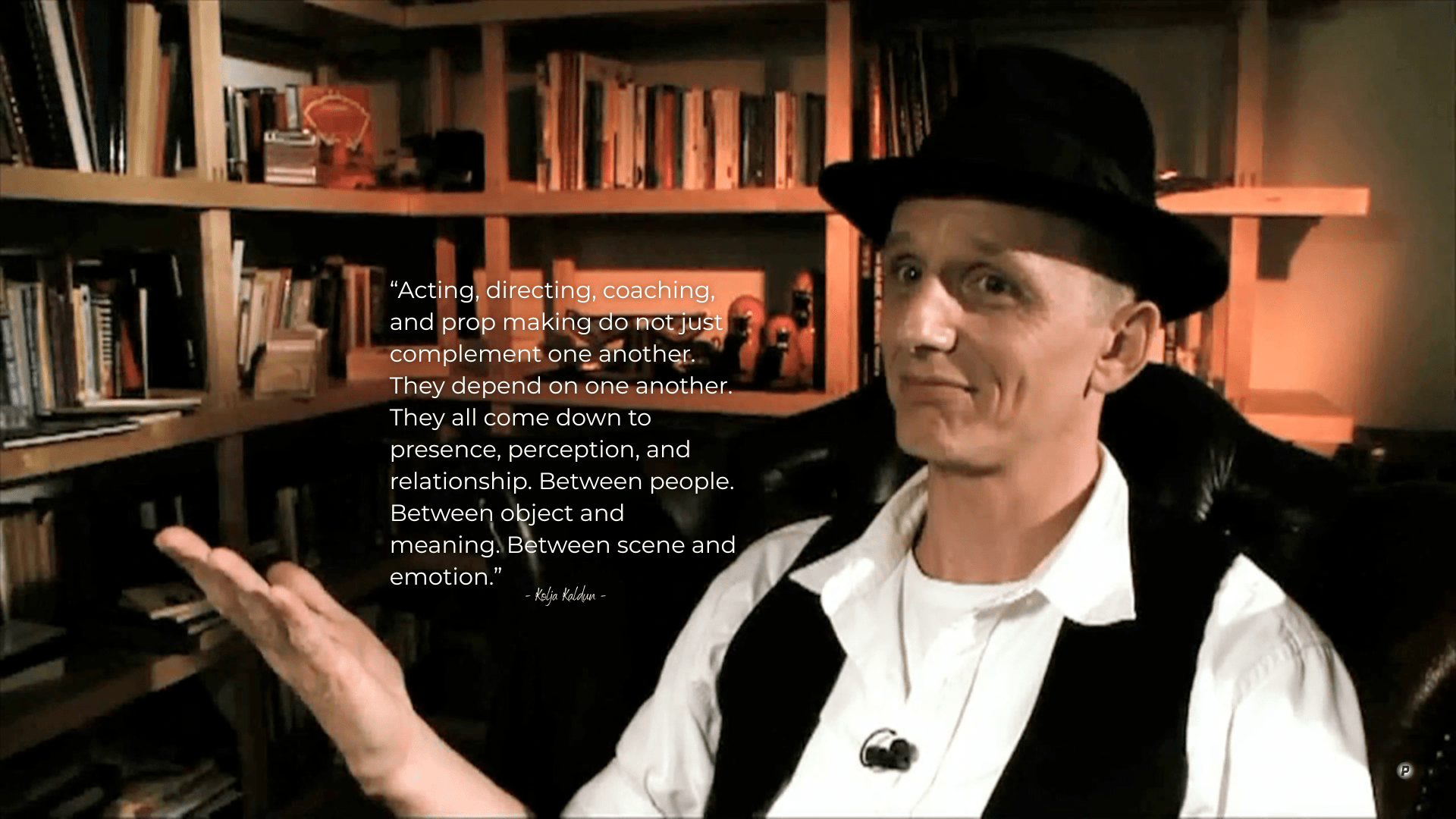
As Kolja puts it, “acting, directing, coaching, and prop making do not just complement one another. They depend on one another. In every field, it comes down to presence, perception, and relationship. Between people. Between object and meaning. Between scene and emotion.”
And once that relationship exists, belief follows.
And once belief is there, a story can truly begin.
The Student Question That Opened a Door
For two decades, Kolja’s creative world revolved around the theatre classroom. Film was never the goal, never the strategy.
Until one day, a student asked him if they could try working with film.
At that point, Kolja had only occasionally been in front of the camera. He appeared as a magician in a student short film, “The Art of Entertainment” by Rouven Koehnen, and in a music video by the Berlin band Zweiraumwohnung. He also took part in art projects such as “Trugbilder” by Anne Anders. Film existed around him, but it was not yet his main creative home.
Following the student’s curiosity, Kolja joined a multi-part professional development course to learn the technical fundamentals of filmmaking. He did not disappear into theory. He learned in practice, together with his students.
He calls it learning by teaching. Trying things. Making mistakes. Learning from them. Even acquiring his own film equipment. As he put it: “What began as a pedagogical experiment developed into a genuine passion”. Indeed, what started in the classroom eventually grew into something much larger.

Today, what excites him most about filmmaking is the way it brings stories, acting, emotions, and craftsmanship together in a single medium. And as a passionate teacher, he is committed to passing that spark on to his students. Because: “young people should not only connect with acting and atmospheric storytelling, but also with the technology behind it.”
At this point, focusing more seriously on filmmaking, and especially on prop making, felt like a natural progression. Almost as if this path had been forming for years, long before Kolja gave it a name.
The Secret Life of Props
However, the biggest challenge in prop making, especially in independent theatre productions, is working with limited means and budgets. Despite that, Kolja leans in. He approaches the challenge with curiosity and care, guided by a deep respect for craft. His goal is not surface level realism, but to uncover the meaning an object can carry.
He puts it simply: “authentic does not come only from looking real. It comes from details in the full context. A good prop shapes atmosphere, rhythm, and often the psychology of a character.” In his words, the prop is a silent storyteller in the background.
That belief shapes his entire process. Every project begins with deep research. He gathers reference images, technical drawings, and real world examples, not only to understand how an object looks, but also what role it plays within the story.
Hence, browsing online auctions has become part of his routine. Sometimes he finds exactly what he is looking for. Other times, he stumbles upon unexpected objects that spark new ideas. When budgets allow, he buys original pieces and modifies them. To Kolja, the traces of use on these objects are irreplaceable. They already carry their own history.

When he builds props himself, aging becomes a central element of the work. Over the years, he has experimented with many techniques to make surfaces feel convincingly lived in. He often starts with surprisingly simple materials such as vinegar, hairspray, scouring milk, or heavily diluted paint. Small scratches, fine cracks, and worn edges breathe life into an object.
One of his favorite areas is working with paper. Old documents, letters, and ID cards created for fictional characters quietly deliver information. They reveal time, place, and social belonging, and they create an intimate closeness to the character.
To make these documents feel as real as possible, Kolja does not simply print them. He types them on old paper using a typewriter and adds real stamps that he makes himself. He then ages them carefully through folding, subtle discoloration, and minimal traces of use. The goal is never to overdo it. As he puts it, “less is more. Too much patina looks artificial.” More than just once, he had to remake a document just because he overdid it.

For those who want to explore this craft more deeply, Kolja recommends Designing Graphic Props for Filmmaking by Annie Atkins and Praktische Grundlagen der Bühnenplastik und Bühnenmalerei by Julie Louise Speck. Both books offer valuable insight into how thoughtful prop design can shape the world of a story.
Staying open
Kolja Kaldun’s journey is not defined by titles or disciplines, but by the way he moves between them. Stage and film. Craft and psychology. Experience and curiosity. What connects everything he does is a deep respect for people, for stories, and for the objects that help make those stories believable.
And if there is one thing his path makes clear, it is this: the most powerful work grows from curiosity, from taking craft seriously, and from staying open. Open to collaboration. Open to adaptation. Open to learning something new.
Connect with Kolja:
Kommentar verfassen